Battery autonomy calculator
Enter the bank you have, or the one you are pricing, and the daily load it must carry. The result is how many days it lasts with no charging at all, after depth-of-discharge and inverter losses. The answer is a floor: any sun, or a generator, extends it.
Result
- Days of autonomy
- Usable energy
Assumes no charging and a constant daily load for the whole period.
How this is calculated
Nominal energy in the bank is amp-hours times volts. Only the depth-of-discharge fraction of it is available without harming the cells, and only the inverter-efficiency fraction of that reaches the outlets. Divide what is left by the daily load and you have days.
Usable Wh = Ah × V × DoD × inverter efficiency
Days of autonomy = usable Wh ÷ daily load Wh
Depth of discharge is a design choice, not a property of the battery alone. Lithium iron phosphate cells tolerate 80% routinely, and the Cochise County solar guides use 0.80; lead-acid life falls off sharply below 50% and the same guides use 0.50. The input is clamped to 0.10–1.00. Inverter efficiency covers conversion loss and the inverter's own idle consumption, averaged over a day; 0.90 is the working figure. Set it to 1.00 if the load is DC only, for instance a 12 V pump and lights with no inverter in the circuit.
The result is a floor, not a forecast. It assumes zero charge over the whole period and a load that does not change. Two things pull the real figure down: cold, and age. Lead-acid gives up a meaningful share of its rated capacity in the cold and more again at high discharge rates (the Peukert effect); LiFePO4 holds capacity better in the cold but most cells will not accept charge below 0 °C without a heater. A bank in year five has less capacity than its label. Two things push it up: any sun at all, and shedding load once you see the storm coming.
Inputs are clamped to 1–100,000 Ah, 12–96 V, DoD 0.10–1.00, inverter efficiency 0.70–1.00 and load 1–10,000,000 Wh. Out-of-range entries show a message and no result rather than a nonsense number.
Cochise County defaults
Autonomy target: 2 days, 3 if the site is unattended with no generator. The Sulfur Springs Land Management guide calls 2–3 days typical and more than 5 "rarely cost-effective". The Cochise Land Management guide reports that a propane or diesel generator lets you cut the bank by 25–50%, which is usually cheaper than the batteries it replaces. Winter is the test. A fixed 32° array at Sunsites models at 5.66 kWh/m²/day in December against 7.91 in April (PVGIS, ERA5 2005–2023, in the Cochise Land Management SSVEC post), and a Pacific storm train can cut that to a fraction for two or three days running.
Chemistry and voltage. Use 0.80 DoD and 48 V for a LiFePO4 bank; 0.50 DoD for lead-acid. The county guides put LiFePO4 at 6,000–10,000+ cycles and lead-acid at 3,000–5,000, so the lithium bank cycled to 80% outlasts the lead bank cycled to 50% by years. At 4,000–5,000 ft, winter nights below freezing are routine; a bank in an unconditioned shed needs a heated case, an insulated enclosure that the batteries' own charge keeps above 0 °C, or a 10–15% margin on the result.
Load. Measure it. A plug-in meter on the refrigerator and the well pump for a week gives a better number than any table, and the pump's cycling is usually the surprise. The Cochise Land Management guide puts a modest home with minimal air conditioning at 10,000–15,000 Wh/day and an average home with some AC at 15,000–25,000. A minimal cabin on a 12 V fridge and LED lights can run under 3,000. The spread is a factor of ten, which is why measuring beats guessing.
Arizona's 2026 solar law. Battery storage sold or installed by a licensed contractor as part of a solar energy device falls under A.R.S. 44-1762 as amended by Senate Bill 1419 (Laws 2026, Chapter 175): a written warranty statement with performance data, a certificate of compliance, and at least two years' warranty on storage units and their installation. Owner-installed systems are exempt under subsection F. See the Cochise Land Management summary.
A worked example
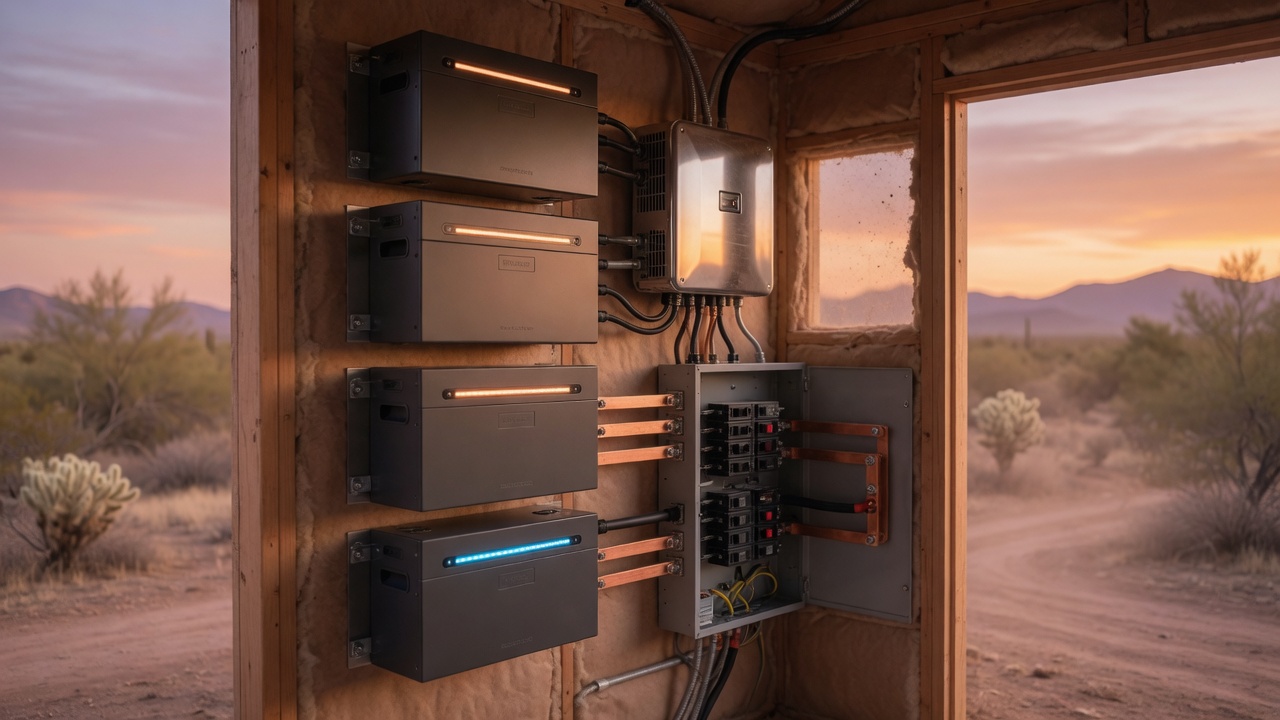
Four 48 V, 100 Ah LiFePO4 rack batteries in parallel: 400 Ah at 48 V, 19.2 kWh nominal on the label. Depth of discharge 0.80, inverter efficiency 0.90, daily load 6,000 Wh (the cabin from the sizing example).
Usable: 400 × 48 × 0.80 × 0.90 = 13,824 Wh = 13.82 kWh. Days: 13,824 ÷ 6,000 = 2.3 days. The same bank against a 3,000 Wh load (the page default) gives 4.61 days.
For contrast, two 12 V 100 Ah AGM batteries in parallel on a 1,200 Wh/day shed load: 200 × 12 × 0.50 × 0.90 = 1,080 Wh, 1.08 kWh, 0.9 days. One overcast day empties it to the 50% line.
What this does not cover
Solar input during the outage, which this page sets to zero on purpose. Generator run time and charger current. The battery management system's actual low-voltage cutoff, which may stop discharge before your chosen DoD. Peak power: a bank can hold the energy and still fail to start a well pump if its BMS current limit is too low, and that is a separate check (a 100 A BMS at 48 V caps continuous discharge at roughly 4.8 kW; at 12 V, about 1.2 kW). Temperature derating, cell imbalance, cable losses and inverter surge ratings. Load scheduling, which is the cheapest autonomy there is.
This is arithmetic on numbers you supply. It is not an electrical design, a warranty statement or a permit document. Have the bank, BMS and inverter matched by the installer who will warrant them, or by a licensed electrical contractor if you are building under the owner-builder exemption.
FAQ
Do amp-hours add up in series or in parallel?
Parallel adds amp-hours at the same voltage; series adds voltage at the same amp-hours. Four 12 V 100 Ah batteries in series are 100 Ah at 48 V; in parallel they are 400 Ah at 12 V. Both hold 4.8 kWh. Enter the bank as wired: the Ah figure at the bank's nominal voltage.
Why does the calculator multiply by inverter efficiency?
The daily load is measured on the AC side, at the outlets. The battery supplies DC, and the inverter loses roughly a tenth of it as heat plus its own idle draw. Usable energy is therefore Ah × V × DoD × 0.90, and the result is about 10% fewer days than the bare Ah × V arithmetic suggests.
Is this the same battery number the solar sizing calculator gives?
It is the same formula run backwards. The sizing calculator starts from a target number of days and returns a bank size; this one starts from a bank you have or can buy and returns the days it covers. For 6,000 Wh/day the sizing page asks for 347 Ah at 48 V for 2 days; entering 347 Ah here returns 2.0 days.
Sources
- Sulfur Springs Land Management, "Off-Grid Solar Sizing for Cochise County Properties" — autonomy 2–3 days, LiFePO4 0.80 / lead-acid 0.50, cycle-life figures, loss breakdown.
- Cochise Land Management, "Off-Grid Solar System Sizing Guide for Cochise County" — generator reduces battery requirement 25–50%; typical daily loads.
- Cochise Land Management, "Grid Power or Solar? What an SSVEC Line Extension Actually Costs" — PVGIS monthly output at Sunsites, 32° tilt.
- A.R.S. 44-1762, Solar energy device warranties; installation standards; inspections
- Cochise Land Management, "Arizona's 2026 Solar Law: What an Off-Grid Buyer Must Now Be Handed" — SB1419, Laws 2026 Ch. 175.
Related guides
Gear for this job
Affiliate links — AZ Land List may earn a commission from purchases at no extra cost to you.
-
AmazonLitime 12 V 100 Ah LiFePO4 batteryBuilt-in 100 A BMS. Drop-in lead-acid replacement at roughly half the weight; four in series make a 48 V, 100 Ah string.
-
AmazonVictron SmartShunt 500 A battery monitorBluetooth state-of-charge monitor. The only way to know where the bank actually is, which this calculator cannot tell you.
-
AmazonBLUETTI Apex 300 + B300K expansion batteryModular LiFePO4 power station with a stacking expansion battery. A plug-in alternative to a built bank for a small cabin load.
Buying, or already own, the parcel?
The Cochise County Land Owner Pack has every vacant parcel with zoning, road access, wells and flood flags. The day-one gear list is what to bring the first time you drive out. And for a contractor quote on clearing, grading or a driveway in Cochise County, Cochise Land Management refers you to independent, ROC-licensed contractors.
Find your county’s assessor, zoning and treasurer pages →