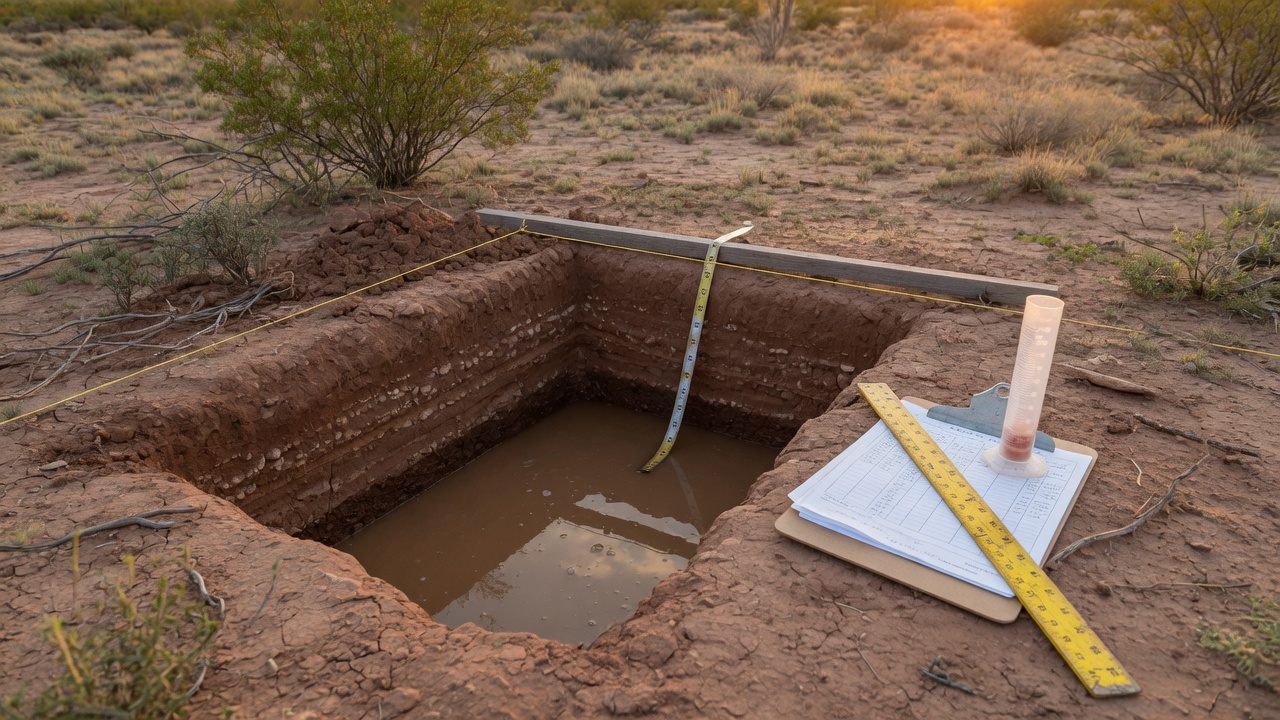
Arizona septic tank and leach field size calculator
Enter the bedroom count and the perc rate from your soil evaluation. The calculator reads the design flow and minimum tank capacity from A.A.C. R18-9-A314, the soil absorption rate from R18-9-A312, and returns the minimum trench or bed area for a conventional system under Arizona's 4.02 General Permit. It is a planning number, not a design.
Result
- Design flow
- Septic tank (minimum)
- Soil absorption rate used
- Disposal area (minimum)
- Disposal method
Tank and flow: A.A.C. R18-9-A314(4)(a)(i). Absorption rate: R18-9-A312(D)(2)(a). Area is design flow divided by absorption rate, rounded up to the next square foot. Your evaluator's design controls.
How this is calculated
Arizona sizes a conventional septic system with two tables in the Arizona Administrative Code, Title 18, Chapter 9. The calculator applies both and does nothing else.
Tank and design flow. A.A.C. R18-9-A314(4)(a)(i) lists, for a single-family dwelling, the minimum design liquid capacity of the tank and the daily design flow by bedroom count. Each bedroom row has two lines: one for a house at or under a fixture-unit threshold, one for a house over it. The threshold is 7 fixture units per bedroom (7, 14, 21, 28, 35, 42, 49, 56). The fixture-unit values for sinks, toilets, tubs and so on are in R18-9-A314(4)(a)(ii). A 3-bedroom house at or under 21 fixture units gets a 1,000-gallon tank and 450 gallons per day; over 21 it gets 1,250 gallons and 600 gallons per day. The table stops at 8 bedrooms. Larger dwellings and non-residential buildings are sized from design flow under R18-9-A314(4)(b): tank capacity is 2.1 times the daily design flow.
Soil absorption rate. R18-9-A312(D)(2)(a) converts the percolation rate, in minutes per inch, into a soil absorption rate (SAR) in gallons per day per square foot. There are two columns: one for trenches, chambers and seepage pits, one for beds. The table runs from 1.20 gpd/ft² (trench) at 1 to under 3 min/inch down to 0.20 gpd/ft² at 60 to 120 min/inch. Below 1 min/inch and above 120 min/inch the table says "site-specific SAR required". When your measured rate falls between two listed rows, R18-9-A312(D)(2)(c) says to use the higher (slower) listed rate, which gives the more conservative SAR. The calculator does that: a 32 min/inch result is treated as the 35 min/inch row.
Disposal area. The minimum absorption area is the design flow divided by the SAR, rounded up to the next square foot.
That area is the bottom area of the trenches or bed, not the lot footprint. How it becomes linear feet of trench depends on trench width, depth and spacing, which R18-9-E302 (the 4.02 General Permit for a septic tank with disposal by trench, bed, chamber technology or seepage pit, design flow under 3,000 gallons per day) sets and your designer lays out. Chamber systems use the trench column.
Cochise County defaults
- Who permits. Cochise Health and Social Services, Environmental Health Services Division, issues the onsite wastewater permit under delegation from the Arizona Department of Environmental Quality. Septic inspection line: 520-432-9441. Environmental Health office: 1415 W. Melody Lane, Suite E, Bisbee, 520-586-8206.
- What comes first. The county requires a soil and site evaluation before you apply, done by a state-certified evaluator: an Arizona registered professional engineer, registered geologist, registered sanitarian, or someone holding a certificate from an ADEQ-recognized course. The evaluator excavates at least three test pits, two in the primary disposal area and one in the reserve area, to 12 feet, and designs the system. Site the septic before you place the house or the well; the county's own guidance says it is easier to move buildings on paper.
- Perc rate. There is no county default. Soils here range from fast decomposed granite and sandy loam on the bajadas to slow clay and cemented caliche on the valley floors, often on the same parcel. Type what your evaluator measured. An NRCS Web Soil Survey map unit is a hint, not a perc rate.
- Bedrooms. Leave the fixture-count box unchecked for a normal house. Check it if you are adding a second kitchen, a second laundry, or several extra bathrooms; your designer will count fixture units from R18-9-A314(4)(a)(ii) and tell you which line you are on.
- Maintenance. The county's guidance is to pump the tank every 3 to 5 years of normal use, clean the effluent filter about once a year, and not add chemical or bacterial additives.
A worked example
A 3-bedroom house on the east side of the Sulphur Springs Valley, typical fixture count, trench disposal, with the evaluator reporting 45 min/inch in clay loam. From R18-9-A314: design flow 450 gal/day, minimum tank 1,000 gal. From R18-9-A312 at the 45 min/inch row, trench column: SAR 0.29 gpd/ft². Area: 450 ÷ 0.29 = 1,551.7, rounded up to 1,552 ft² of trench bottom.
Same house and soil as a bed: SAR 0.20 gpd/ft², area 450 ÷ 0.20 = 2,250 ft². Same house with the fixture-count box checked (more than 21 fixture units): 600 gal/day, 1,250-gallon tank, 600 ÷ 0.29 = 2,069 ft². With the default 15 min/inch the trench area is 450 ÷ 0.50 = 900 ft². The slow-soil case needs 72 percent more trench than the default; that difference is what caliche costs you.
What this does not cover
- It is not a system design and not a permit application. The evaluator who dug the pits designs the system, and the county reviews it.
- Setbacks from wells, property lines, washes and structures; depth to groundwater or to an impervious layer such as caliche; slope. Any of these can change the disposal location or the system type.
- The reserve disposal area. Arizona requires space for a replacement field; the calculator sizes only the primary area.
- Trench geometry. Converting bottom area to linear feet of trench, chamber count or bed dimensions follows R18-9-E302 and your designer's layout.
- Perc rates under 1 min/inch or over 120 min/inch, and any soil where the evaluator calls for a site-specific SAR. The calculator shows a note and leaves the area blank.
- Alternative systems (R18-9-E303 to E323): mounds, sand filters, aerobic units, composting toilets. Different permits, different sizing.
- Fees, installed cost and timelines. The county does not publish its septic fee schedule online; call Environmental Health.
Sources
- A.A.C. R18-9-A314 — Septic tank design, manufacturing and installation; tank capacity and design flow table at (4)(a)(i), fixture units at (4)(a)(ii).
- A.A.C. R18-9-A312 — Facility design for Type 4 onsite wastewater treatment facilities; soil absorption rate table at (D)(2)(a), between-row rule at (D)(2)(c).
- A.A.C. R18-9-E302 — 4.02 General Permit: septic tank with disposal by trench, bed, chamber technology or seepage pit, less than 3,000 gallons per day.
- Cochise County — Septic Systems and Private Wells — permit process, evaluator qualifications, test pit requirements, inspection line, maintenance guidance.
- UA Cooperative Extension — County contacts for onsite wastewater treatment systems (Nov 2025) — Cochise County Environmental Health address and phone.
Related guides
FAQ
What perc rate is too slow for a conventional septic system in Arizona?
Arizona's soil absorption rate table (A.A.C. R18-9-A312(D)(2)(a)) stops at 120 minutes per inch. Slower than that, or faster than 1 minute per inch, the rule requires a site-specific soil absorption rate and the system is usually an alternative design under R18-9-E303 to E323 rather than a plain tank and trench.
How big a septic tank does a 3-bedroom house need in Arizona?
Under A.A.C. R18-9-A314(4)(a)(i), a 3-bedroom single-family dwelling with 21 or fewer fixture units needs a minimum 1,000-gallon tank at a design flow of 450 gallons per day. With more than 21 fixture units it is 1,250 gallons and 600 gallons per day.
Who issues septic permits in Cochise County?
Cochise Health and Social Services, Environmental Health Services Division, under delegation from the Arizona Department of Environmental Quality. The county requires a soil and site evaluation by a state-certified evaluator before you apply. Septic inspection line: 520-432-9441.
Gear for this job
Affiliate links — AZ Land List may earn a commission from purchases at no extra cost to you.
Buying, or already own, the parcel?
The Cochise County Land Owner Pack has every vacant parcel with zoning, road access, wells and flood flags. The day-one gear list is what to bring the first time you drive out. And for a contractor quote on clearing, grading or a driveway in Cochise County, Cochise Land Management refers you to independent, ROC-licensed contractors.
Find your county’s assessor, zoning and treasurer pages →