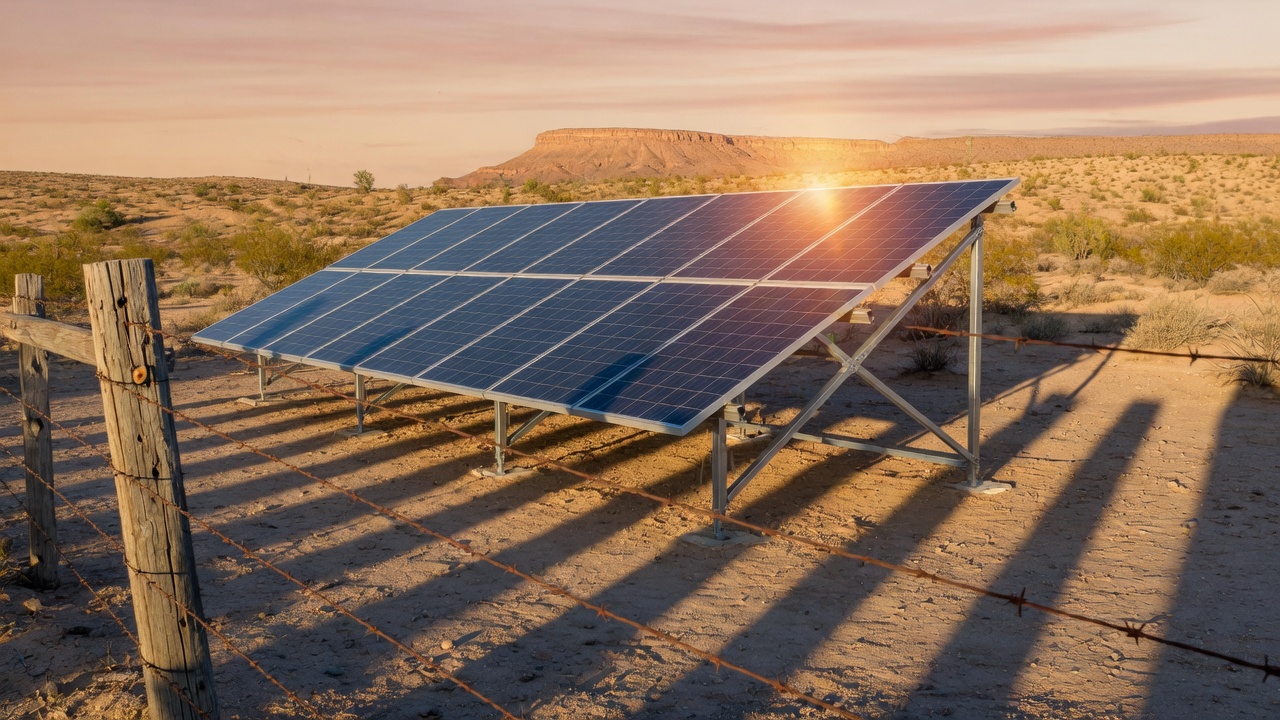
Solar panel tilt calculator
Enter your latitude and whether the array should favour the whole year, the winter or the summer. The result is a tilt angle from horizontal and the true compass direction to face. It is the latitude rule of thumb, stated plainly, with the Cochise County numbers worked out.
Result
- Tilt angle
- Azimuth
- Facing
Tilt is measured from horizontal. Azimuth is true, not magnetic.
How this is calculated
A panel collects the most direct sunlight when it faces the sun squarely. Over a year the sun's noon elevation averages out to 90° minus your latitude, so a panel tilted up from horizontal by the latitude angle is square to the average noon sun. That is the whole rule. The U.S. Energy Information Administration states it the same way: tilting a panel toward the equator at an angle equal to its latitude maximises its annual exposure to direct sunlight.
Annual tilt = |latitude|
Winter tilt = |latitude| + 15°, capped at 90°
Summer tilt = |latitude| − 15°, floored at 0°
The 15° seasonal offset is a convention, not a derived constant. The sun's noon elevation swings ±23.44° (the axial tilt) between the solstices; 15° is a compromise that captures most of the winter gain without pointing the panel at the ground in summer. The calculator takes the absolute value of latitude, so −33.9° and +33.9° give the same tilt. Azimuth follows the hemisphere: 180° (true south) when latitude is zero or positive, 0° (true north) when it is negative. A site on the equator faces south by convention; either direction is equivalent there.
Latitude is clamped to −90° to 90°. Entries outside that range show a message and no result.
Cochise County defaults
Latitude 31.3°–32.3° N. Douglas is 31.35°, Sierra Vista 31.55°, Sunsites 31.94°, Willcox 32.24°. Annual tilt is therefore 31°–32°, winter 46°–47°, summer 16°–17°. The county is in the northern hemisphere so the array faces true south, azimuth 180°.
Pick the winter bias if the array is fixed and the system is off-grid. The reason is in the monthly numbers. Cochise Land Management modelled a fixed array at Sunsites at 32° tilt, due south, with PVGIS (ERA5, 2005–2023): December 5.66 kWh/m²/day, April 7.91, July 6.16, annual mean 6.78. The spread between the best and worst month is 40%, and the worst month is the one an off-grid system is sized for. A steeper tilt raises December at the expense of April and July, and April and July are months with surplus. The monsoon is why summer bias buys little here: July output sits about 22% below April because of afternoon cloud, so a flatter panel chases sun that is behind cloud.
An independent model agrees on the shape. ProfileSolar's NASA POWER run for Pearce puts the best fixed tilt at 28° facing south, and the seasonal tilts at 47° winter, 37° autumn, 25° spring and 16° summer. The fixed optimum is a few degrees shallower than latitude because clear-sky summer days contribute more energy than the latitude rule assumes; the winter figure matches this calculator's 46°–47°.
Finding true south. A compass reads magnetic north, which in Arizona is several degrees east of true north. Either correct the compass with the declination for your site from NOAA's geomagnetic calculator, or use the sun: at solar noon the sun is due south and the shadow of a plumb stake points due north. The solar position calculator gives solar noon for your longitude (about 12:18 to 12:21 MST at 109.9° W). Arizona stays on Mountain Standard Time all year under A.R.S. 1-242, so there is no daylight-saving correction.
If the rack is adjustable, the county guides and the ProfileSolar figures agree on a two-position schedule: about 45° from October to March and about 20° from April to September. Four positions buy little more.
A worked example
A ground-mount array at Sunsites, latitude 31.94° N, off-grid, fixed rack. Winter bias: 31.94 + 15 = 46.9° from horizontal, azimuth 180°, facing south. Annual bias would be 31.9°, summer 16.9°. A 2,000 W array (the sizing example) on a rack at 46.9° has its top edge about 2.5 m above its bottom edge for a two-panel-high portrait layout of 1.7 m panels (3.4 m × sin 46.9°), so the rack needs a footing that holds it against monsoon wind from the north.
The same calculator for a site at 33.9° S (southern hemisphere) with winter bias returns 48.9°, azimuth 0°, facing north. Entering the latitude as negative is what flips the direction; nothing else changes.
What this does not cover
This is a rule of thumb, not an irradiance model. It does not know your horizon, the mesquite to the south-west, the ridge that blocks the first hour of December sun, or the row spacing that lets the front row shade the back one at a steep winter tilt. It does not weigh diffuse light, which favours flatter tilts, or dust, which a steeper tilt sheds better and which matters in a dry valley with graded roads. It does not size the rack, its footings or its wind loading; 46° panels present a large face to wind and the ground-mount manufacturer's engineering, or a licensed contractor's, governs that. It does not cover trackers, bifacial modules, east-west split arrays or roof pitches you cannot change.
For a real optimum, run PVWatts or PVGIS for your coordinates at several tilts and read the December row. The right answer is the tilt that clears December with the fewest panels, and that is a site number, not a latitude number.
FAQ
Should off-grid panels in Arizona be tilted to latitude or steeper?
Steeper, if the array is fixed and you design to December. At Cochise County latitudes (31.3°–32.3° N) that is 46°–47°. Latitude tilt (about 32°) gives the most energy over a year, but an off-grid system is sized to its worst month, and the winter bias trades surplus April and July energy for December energy you can use.
Is the azimuth true south or magnetic south?
True south, 180°. A compass points to magnetic north, which in Arizona is several degrees east of true north. Correct the compass with the declination from NOAA's calculator, or skip the compass: at solar noon the sun is due south and a vertical stake's shadow points due north. The solar position calculator gives solar noon for your site.
How much does tilt matter compared with adding a panel?
Less than people expect, more than azimuth. The county solar guides put the loss from a non-south orientation at 10–25%. Changing a fixed tilt by 15° moves energy from one season to another; it does not create much. One extra panel in a five-panel array is 20% more in every month. Tilt is free; a panel is not. Get the tilt right and then buy the panel.
Sources
- U.S. EIA, Today in Energy: fixed-tilt and tracking solar — tilt equal to latitude maximises annual exposure to direct sunlight; shallower tilts favour spring and summer.
- Cochise Land Management, "Grid Power or Solar? What an SSVEC Line Extension Actually Costs" — PVGIS monthly output at Sunsites, 32° tilt: Dec 5.66, Apr 7.91, Jul 6.16, annual 6.78 kWh/m²/day.
- ProfileSolar, Pearce, Arizona (NASA POWER) — 28° fixed optimum; seasonal 47° / 37° / 25° / 16°.
- Sulfur Springs Land Management, "Off-Grid Solar Sizing for Cochise County Properties" — 32° year-round or 40–45° winter; 10–25% loss off south.
- NOAA NCEI geomagnetic calculators — magnetic declination for compass correction.
- A.R.S. 1-242, Standard time; exemption from daylight saving time
Related guides
Gear for this job
Affiliate links — AZ Land List may earn a commission from purchases at no extra cost to you.
-
AmazonAdjustable solar panel tilt mount brackets (4-pack)Adjustable-angle brackets for ground or roof mounting of 100–400 W panels. Set them once at the winter angle, or twice a year.
-
AmazonSUNGOLDPOWER expandable ground-mount kitSteel ground rack for two full-size panels, tilt-adjustable, extendable for larger arrays. Footings and wind loading are on you.
Buying, or already own, the parcel?
The Cochise County Land Owner Pack has every vacant parcel with zoning, road access, wells and flood flags. The day-one gear list is what to bring the first time you drive out. And for a contractor quote on clearing, grading or a driveway in Cochise County, Cochise Land Management refers you to independent, ROC-licensed contractors.
Find your county’s assessor, zoning and treasurer pages →